|
Among the contemporary saints of the great saint of Shirdi, Shri Sai Baba, Sant Gadge Maharaj holds a unique place. Shri Gadge Maharaj did spread the message of Bhagavad Gita through his kirtans; but that was not his only goal. He worked tirelessly throughout his life to free the entire society from its habits and vices. The entire Maharashtra and Marathwada region was stirred by His thunderous kirtans and the kirtans of about 100-150 preachers who called themselves his disciples. History will not fail to bear witness to the work done by Sant Shri Gadge Maharaj and his followers for almost forty years by way of preaching and educating two generations in Maharashtra which is unparallel indeed! Debuji Zhingraji Janorkar popularly known as Sant Shri Gadge Maharaj or Gadge Baba was born on 23rd February 1876 in Shedgaon village in Daryapur taluk of Amravati district of Maharashtra. His father's name was Jingraji. He belonged to Parit (Washerman) by caste and was engaged in the business of washing clothes for generations. Smt.Sakhubai, who was the daughter of Hambirrao Kolaskar of Dapure village in Purnakat, was the mother of Gadge Maharaj. Jingraji had a small farm and a laundry business. However, he was addicted to alcohol. Hence, Gadge Maharaj was forced to leave everything and left his village and went to live with his uncle Yadavji in Kotegaon. Gadge Maharaj's childhood name was Debu. Jingraj’s health got deteriorated due to alcohol and he died within a few days of Gadge Maharaj’s arrival in Kotegaon. Hence, his mother Smt.Sakhubai came along with young Gadge Maharaj to stay with her father Shri.Hambirrao, in Dapure village in Purnakat. Young Debuji was treated well by his uncle Hambirrao. As a young boy Gadge Maharaj was also good at working in the farm of his family. Debuji's daily routine was to take care of the cattle in the house and do the agricultural work with all his might. Since his family's business was farming, there was plenty to eat and drink, and hence Debuji became very strong and healthy. His body became very strong due to his leisurely swimming in the waters of Purna and his hard work. The well-built body he had earned as a child and the habit of working hard benefited Gadge Maharaj greatly in his later life. Debuji started to like singing bhajans with his other siblings. He was exceptionally intelligent. Due to his family circumstances, he did not receive school education; however, since he had good comprehension skills, he learned Abhangs and spiritual couplets, songs, etc. just by listening and started reciting them. In later years, after he became famous as Gadge Maharaj, he began to use all of his skills in his kirtans in a beneficial way. When Debuji was fifteen or sixteen years old, he was married to a seven-eight year old girl named Kuntabai who was the daughter of Dhanaji Khallatkar from Kamalpur. Debuji's grandfather had taken some loans from a moneylender in Sangvidurgade village near Dapuna. He had paid Money from time to time; however, he had not settled the full amount. Taking advantage of this, the moneylender took a loan from Hambirrao and tried to take possession of his land. However, Debuji singlehandedly confronted the moneylender and his mercenary Purbhayye and forced the moneylender to return the amount to his grandfather.
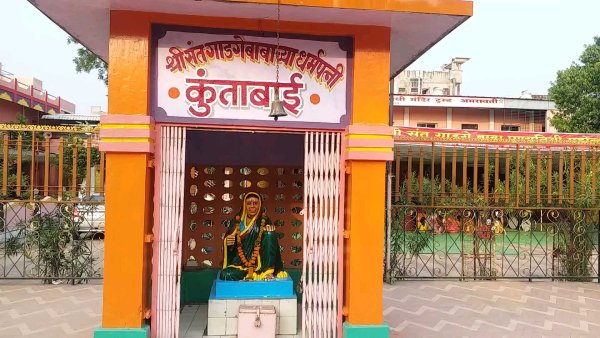
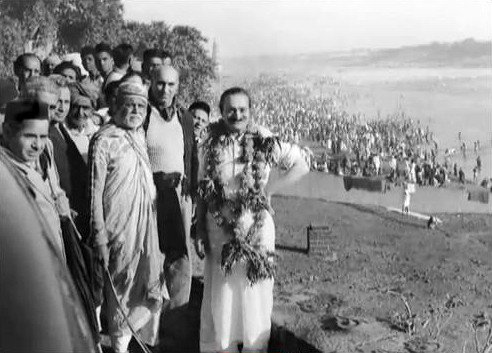
Gadge Maharaj's wife Smt.Kunta Bai's Samadhi Mandir Debuji had his first daughter after marriage, named Aloka. After her, another daughter was born, named Kalavati. Two years later, a son was also born. His name was Mugdal, but he was short-lived. Village people started saying that the goddess had taken the child away because she had not received the goat or a cow and alcohol as a sacrifice. Debuji did not know what to reply for this and he became depressed. In such a situation, in the year 1905, when Debuji went out to protect the jowar in the Khairi forest, he met a man coming from the Khairi village. No one ever knew what he and Debuji talked about; But within two or four days later, a kirtankar (singer) came to the village. Debuji, who had gone to attend his kirtan, was overwhelmed and after the kirtan ended, he returned home with the clothes on his body, a basket lying in the courtyard and a stick lying on the other side, with the intention of working for the benefit of the people for the rest of his life! As we know, Prince Siddhartha, seeing his wife and son in such a state, left home and later became a Buddha. Similarly, Debuji also looked at Kuntabai, Aloka and Kalavati, who were sleeping peacefully in the house. He cast a loving glance at his daughters and wiping away his tears, secretly left the house with a very heavy heart! His family members searched a lot in Dapuna and nearby villages, but he could not be found anywhere. Finally, Sakhubai, Kuntabai and others went on a pilgrimage to Fair at Sarteshevati Runamochan as planned earlier by Debuji family with an intention of meeting him there. The family were successful indeed in meeting Debuji in the fair but despite their repeated plea, Debuji refused to return home. He also expressed his determination to devote the rest of his life to public service! Gadge Debuji who left his uncle’s home in later years came to be known as Gadge Maharaj as he people started calling him by that name. Since childhood, Gadge Maharaj had carefully observed the situation around him. Also, after leaving home, he became particularly aware of the poverty present while wandering around the villages of Maharashtra. Witnessing the Bahujan community suffering due to their addiction to alcohol and extravagance in weddings, people in debt, the spread of false beliefs due to lack of education, the naive belief of people in fathers and mothers, the emphasis on sacrificing chickens, goats, etc. to the goddess, etc., he felt a longing to do something to uplift this community in order to save it. In order to achieve His goal, he himself, with a broom in his hand, swept during the fair, teaching people about cleanliness so that diseases like measles and epidemics could be reduced. A public teacher, he traveled from one place to another wearing his food pan upturned on his head and carrying his trademark broom. When he entered a village, he would instantly start cleaning the gutters and roads of the village. He also told the citizens of the village that their congratulations would have to wait until his work was done. In return the villagers gave him money. From this money Maharaj built educational institutions, dharmasalas, hospitals and animal shelters. He also began to sing kirtans in his wonderful voice. He conducted his discourses in the form of "Kirtans" in which he would emphasize values like service to humanity and compassion. During his kirtans he would educate people against blind faiths and rituals. He would use Dohas by Saint Kabir in his discourses. Listening to Shri Sant Gadge Maharaj's kirtan was in itself a unique experience. Ektara was the only accompaniment he used for his kirtan. He never used to sit and sing in a fixed place. In the beginning, Maharaj would choose a courtyard near the central temple of a village for his kirtan and without waiting for the lighting of the lamp, he would start singing Abhang in his loud voice. Hearing his melodious songs, people would automatically become enamoured and used to gather there. Afterwards, during the Yatra, Saptah etc., Gadge Maharaj's Kirtan was a big attraction and people used to flock to listen His kirtan. Gadge Maharaj never pretended to be a great Vedantic speaker. Gadge Maharaj used to automatically enter inside people’s hearts by telling them familiar stories with an enchanting smile on His face and would advise them to spiritually uplift themselves. He exhorted people to stop animal sacrifice as part of religious rituals and campaigned against vices such as alcohol abuse. He tried to embody the values that he preached: hard work, simple living and selfless service to the poor. As soon as the kirtan got finished, Maharaj would move away from the place of kirtan and would not let anyone to come near him. If one tried to come near, He used to hit them with his broom on their back. He abandoned his family (wife and 3 children) to pursue this path. Maharaj met the spiritual teacher Meher Baba several times. Meher Baba indicated that Maharaj was one of his favourite saints and that Maharaj was on the sixth plane of consciousness. Maharaj invited Meher Baba to Pandharpur, and on 6th November 1954 thousands of people had Maharaj and Meher Baba’s darshan at Pandharpur.
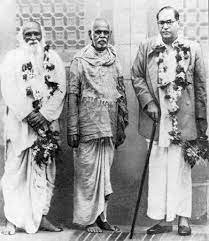
Gadge Maharaj with Meher Baba During his wandering’s, Gadge Baba had seen with his own eyes how children in the villages were deprived of even elementary education. First because there were no schools in the villages and secondly their parents could not afford to keep them in the towns where educational facilities available. Resolving that he must do something for the education of the children in the rural areas, Gadge Baba launched a massive programme of opening schools and building hostels for the rural children. It is to the credit of his tremendous driving force and organizing capacity that he set up as many as 42 educational institutions in different parts of maharashtra catering to the needs of the rural people. These include high schools in larger towns, ashram shalas ( residential schools) for children of the tribal and nomadic communities and hostels for boys and girls. In 1952 , he created a trust, named “ Gadge Maharaj Mission”, to look after the management of these institutions. Seeing the inconvenience caused to the pilgrims at the pilgrimage places, Gadge Maharaj built Dharamshalas, food shelters, etc. in Pandharpur, Nasik, Pune, Dehu, Alandi and other places to facilitate them. He had a special feeling for the lower caste of the society and hence he built separate Dharamshalas for them. The Chokha Mela Dharamshala of Pandharpur is one such place built by Him. He had special compassion for the Harijans, the lame, the blind, the lepers and the destitute old people and wherever possible He himself served these people. Seeing selfless work of Gadge Maharaj, the then Chief Minister of Mumbai, Shri.Balasaheb Kher, gave him a big car to reduce the trouble of moving from place to place and asked him to travel in it. Dr. Babasaheb Ambedkar also had special respect for the service of Gadge Maharaj and had a close relationship with Maharaj. We always hear that miracles happen in the lives of saints. Is it a small miracle that a man like Sant Shri Gadge Maharaj, who had no money, did works worth about fifty lakhs like getting Ghats, Dharamshalas, Old Age Homes, Food Shelters etc. constructed by getting donations from the people?
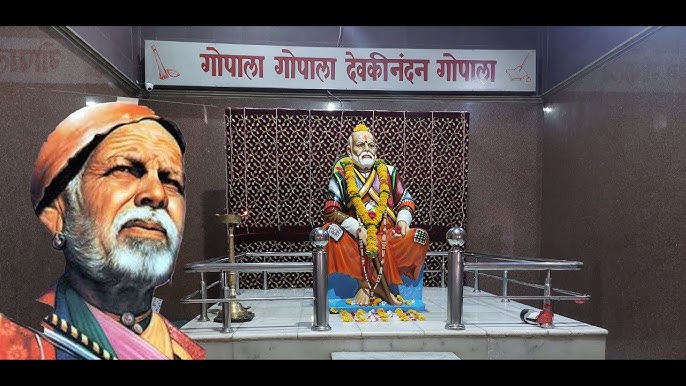
Gadge Maharaj with Ambedkar Once during his visit to Pandharpur Gadge Baba saw an old man lying by the road side in most abject and pitiable condition. The man had starved for many days and was very ill. He was asking for water to the people who passed by him but nobody even cared to look at him. Gadge Baba with his hand of volunteers picked the man and lodged him in one of his cottages, there after so long as Gadge Baba was in Pandharpur he nursed the sick old man, cleaned him and even disposed of his urine and excreta. The man did not however survive long and died of his illness. Gadge Baba had come across many such old men who due to their old age and senile illness were a burden to them selves and their families. Many of them found impossible to adjust with their young people so far as special homes for such old people was a social necessity. Gadge Baba is the pioneer in this field, he built a home for the old and infirm at Valgaon way back in the forties, the example set by him has not however received much attention either of the government or public bodies for few such homes have come up since. Gadge Maharaj’s Meeting With Shri Sai Baba In Sreepada Srevallabh Charitaamrutam (the life of Sreepada Srevallabh) it’s stated that Sreepada blessed one of his devotees named Tirumala Das saying, “You will be born in Maharastra as Gagde Maharaj in the washer man’s caste. You will be pious and render valuable service to the distressed, oppressed and miserable people. In Shiladhi village my incarnation as ‘Samarth Sadguru Sai Baba’ will take place, when I will don a Muslim garb. Then you will certainly obtain my grace. You have a fondness for the image of Baal Krishna, so you can chant the name of “Gopala! Gopala! Deveki Nandan Gopala!” I will always grant you my darshan in your mental eye. And you will work for the welfare of the world as Gadge Maharaj. This is my boon and assurance to you”. Gadge Maharaj believed that ‘cleanliness was godliness’ and was famous for sweeping and keeping the roads and allies clean wherever he went. And he carried a broom with him at all times. He had the habit of continuously singing “Gopala, Gopala Deviki Nandan Gopala” In his early days he was a poor saint who owned only a mud pot, but had a keen desire to build a grand building for charitable work. He was quite successful in building a ‘Dharamshala’ at Pandarpur, When he started building a “Dharamshala” at Nasik the funds suddenly froze. He had only a few rooms built and the work had to be stopped. He was quite disgusted by the turn of events so he decided to go and meet Baba. Just as he climbed the steps of the Dwarka Mai, Baba looked at him and shouted a lot of foul abuses. Gadge Maharaj laughed heartily and so did Baba. Gadge Maharaj knew that hereafter his work would proceed smoothly. Many of his disciples were with him at that time and were upset at what took place; their Guru was insulted and treated badly by Baba or so they thought. Gadge Maharaj hadn’t told Baba the reason for his visit, and neither had Baba asked him anything, yet Gadge Maharaj was extremely happy. And they returned to Nasik. Since Baba had abused and driven his bad fortune the funds soon rolled in and he successfully completed his mission (Ref: Shirdi Diary by G.S. Khaparde and published in Baba’s Divine Symphony – Part 1 by Dr.Vinny Chitluri). This great Saint Sant Gadge Maharaj took Samadhi and transcended to the other end of the shore on 20th December 1956 on his way to Amravati, on the banks of river Pedhi near Valgaon. He was cremated on 21st December 1956 in Amaravati. The Government of India has started a 'Sant Gadgebaba Swachta Abhiyan' in 2000-01 in his honour. This programme awards prizes to villagers, who maintain clean villages.
Gadge Maharaj Samadhi Mandir at Amaravati As Sant Tukaram Maharaj said "Now I live for charity", likewise for about 51 years, since leaving his home in 1905, Sant Gadge Maharaj lived his life not for Himself but only for charitable purpose! Currently almost all organizations build by him are functioning well. Even after so many years since his departure, there is lot of following for him. Government of Maharashtra state also runs a village cleanliness programme named after him. University of Amravati was renamed as Sant Gadge Baba University. (Courtesy: Article by Dr. Shri.D. Parchure, M. A. Ph. D. Executive Editor, Shri Sai Leela Magazine January 1979 Marathi Issue and Translated by Saiamrithadhara, Shirdi Diary by G.S. Khaparde and published in Baba’s Divine Symphony – Part 1 by Dr.Vinny Chitluri and Sant Gadge Baba Amaravati University Library) |